

How Can Preplanning Ease Stress for Loved Ones

There is a particular kind of uncertainty that comes with making funeral decisions for someone we love. Even close families may wonder what the person would have preferred. For those considering cremation services in Holland, MI, discussing arrangements ahead of time can help answer important questions before those decisions become urgent. Preplanning gives us a chance to express personal wishes, honor meaningful traditions, and leave loved ones with clearer guidance.
These conversations are not always easy to begin. At Langeland-Sterenberg Funeral Home, we understand that families may hesitate because they do not want to make an uncomfortable subject part of an ordinary day. Yet a thoughtful conversation now can prevent relatives from having to guess later. Planning does not mean deciding every detail immediately. It means giving the people closest to us a better understanding of what matters.
Why Does Preplanning Reduce Uncertainty for Families?
Preplanning can reduce uncertainty by recording funeral preferences before loved ones are asked to make arrangements. Instead of relying entirely on memories or assumptions, family members have a clearer starting point for decisions about the type of service, personal traditions, and meaningful details.
Imagine two siblings discussing whether their mother would have wanted a formal funeral or a smaller memorial gathering. One remembers her appreciation for family traditions. The other recalls her preference for simple occasions. Both want to honor her, but neither knows which direction she would have chosen.
A conversation held earlier could have clarified those preferences.
We encourage families to think about the questions their loved ones might otherwise face. Would a traditional gathering feel appropriate? Is there a favorite song or reading worth including? Are there people who should be invited to participate?
Writing down these preferences gives relatives something concrete to refer to.
It is equally important to recognize that plans can remain flexible. Preferences may change as circumstances and personal wishes evolve.
The purpose of preplanning is not to control every future decision. It is to make the most meaningful choices easier to understand, giving family members room to focus on remembering someone rather than interpreting unanswered questions.
Which Decisions Can Families Discuss Ahead of Time?
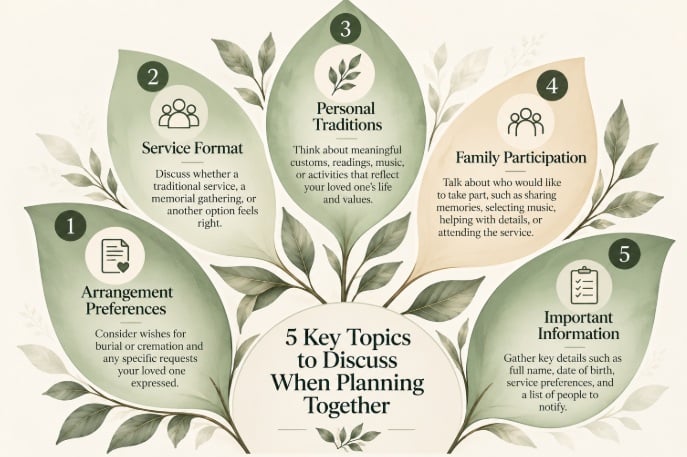
Many people associate funeral planning with choosing between burial and cremation. That decision may be important, but it is only one part of a larger conversation. Families can also discuss the type of gathering they prefer, personal traditions, music, readings, and whether relatives or friends will be involved.
These discussions are often more manageable when we separate essential preferences from details that can remain flexible.
The following table shows how advance conversations may help loved ones understand different aspects of a future service.
| Planning Consideration | What Can Be Discussed Ahead of Time | How It May Help Loved Ones |
|---|---|---|
| Type of arrangement | Preferences for burial or cremation | Reduces uncertainty about a major decision |
| Service format | Funeral, memorial gathering, or celebration of life | Gives relatives a clearer starting point |
| Personal traditions | Meaningful customs, readings, or music | Helps preserve individual wishes |
| Family participation | Preferred speakers or people to involve | Makes participation easier to coordinate |
| Important information | Where written wishes and relevant contacts are kept | Helps relatives locate useful details |
| Flexibility | Choices that matter most and those left open | Allows families to adapt when needed |
A useful takeaway is that preplanning does not require every answer at once.
We can begin with a few important preferences and revisit other details later. Thoughtful guidance for considering arrangements in advance can also help families understand how different service choices may fit their wishes.
How Can Preplanning Prevent Family Disagreements?
Even when relatives care deeply about one another, they may have different ideas about what makes a meaningful farewell. One person might value a traditional ceremony, while another believes a private gathering would better reflect their loved one’s personality.
Without clear guidance, these differences can become difficult to resolve.
Preplanning helps by giving the person’s own preferences a stronger place in the conversation. Rather than debating what someone might have wanted, family members can consider wishes that were discussed or recorded beforehand.
This does not guarantee that every disagreement will disappear. Circumstances may change, and some decisions may still require discussion.
However, planning can make those conversations more focused.
We recommend distinguishing between firm preferences and optional details. Someone may feel strongly about including a particular family tradition but have no preference about the order of music or readings.
Making that distinction gives relatives flexibility without losing sight of what matters most.
It is also helpful to communicate wishes to the people likely to be involved in arrangements. A document that nobody knows about may be less useful when decisions are needed.
When families understand both the wishes and the reasoning behind them, they have a better foundation for respectful discussions.
Why Should Personal Wishes Be Part of the Conversation?
Funeral arrangements are not simply a series of practical decisions. They also provide opportunities to reflect a person’s relationships, values, interests, and traditions.
Preplanning allows us to think about those details while there is time to explain why they matter.
A favorite hymn might remind someone of childhood gatherings. A particular photograph could represent a cherished family memory. Someone who enjoyed gardening may prefer flowers associated with their own garden rather than a formal arrangement.
These details can seem ordinary until relatives are asked to choose them without guidance.
We encourage families to talk about the stories behind their preferences. Explaining why a song, book, or tradition matters can be just as valuable as recording the choice itself.
For example, someone might request a particular piece of music because it was played at their wedding. Sharing that connection helps loved ones better understand its significance.
Families interested in making advance arrangements more personal may find it helpful to begin with familiar memories rather than formal planning questions.
The goal is not to create an elaborate ceremony. It is to preserve the details that genuinely reflect a person’s life.
When Is a Good Time to Begin Preplanning?
There is no single age or life event that determines when someone should begin discussing funeral wishes. For many families, the best time is when people feel comfortable having a thoughtful conversation without the pressure of an immediate need.
An ordinary family gathering may provide a natural opportunity, especially when relatives are already discussing important personal preferences.
The conversation does not need to begin with a complete plan.
We might start by asking whether someone has thought about burial or cremation, what traditions matter to them, or whether they have particular wishes for a memorial gathering.
Listening without pushing for immediate answers can make the discussion more comfortable.
Some people will know exactly what they want. Others may need time to consider the possibilities.
It is also worth remembering that preferences can change. A plan created years earlier may benefit from occasional review, particularly after meaningful changes in family circumstances.
Keeping written wishes accessible and letting trusted relatives know where to find them is another practical consideration.
The greatest value comes from starting a conversation that can continue over time. Families do not need to settle every question in one sitting to make meaningful progress.
Giving Loved Ones Clearer Guidance for the Future
Preplanning cannot remove the sadness of losing someone, but it can reduce some of the uncertainty surrounding funeral arrangements. By discussing preferences, recording meaningful details, and communicating with family members, we can leave clearer guidance for decisions that may otherwise feel overwhelming. For families considering cremation services in Holland, MI, Langeland-Sterenberg Funeral Home can help explain available arrangements and support thoughtful conversations about future wishes. Those ready to begin can also consider practical ways to start a family planning conversation. We welcome the opportunity to discuss the details that matter to you and your loved ones. To speak with our team about preparing funeral wishes in advance, call (616) 392-2306.
